Welcome to the Vertical Extreme
9 min read
Table of Contents [Show]
Your Invitation to Give Climbing a Try
Climbing changed my life. Other than the lifelong influence of my parents, nothing else is more to credit than rock climbing for the man I’ve become and the life I now live. Knowing the life-shaping potential and immense reward of recreating in the vertical extreme, I’ve been quick to share my climbing experiences with friends and strangers alike. It’s my wish that more people experience the rich reward of rock climbing, even if it’s only through the doors of an indoor climbing gym. So in this blog post I’m making my sales pitch to you—why not give climbing a try? Since you’re on KÜHL web site reading this article, chances are you already recreate in the mountains. Why then would you want to climb on an artificial wall indoors, rather than hit the trails of snow and dirt in the mountains? I propose you give indoor climbing a try with the mindset of it being a form of physical "cross training" and mental "challenge training." If you’ve not climbed before, then I guarantee your first climbing gym visit will conclude with a pleasantly drained body, sense of accomplishment, and perhaps even an endorphin-fueled transcendent runner’s high. Furthermore, if you invite a friend, child, or significant other to join in on your climbing session, I trust that you’ll return home feeling more connected with that individual. So what are you waiting for?The Climbing Boom
Rock climbing is said to be the fastest-growing non-team sport of the new millennium, and just this summer it was announced that sport climbing will debut in the 2020 Olympics in Tokyo! While you’ve surely seen breathtaking video of rock climbing on TV, it’s through the doors of an indoor climbing gym that most people get started. Unlike past generations who learned to climb in the more serious environment of outdoor crags, today's aspiring climbers can gain their skills in a safe, controlled indoor setting that offers a mountain-load of fun. And with over 1,000 indoor walls in United States, there’s undoubtedly a climbing gym near you. Regardless of your age, background, or level of fitness, indoor climbing will present you with many unique challenges—and rewards—that are far different from other sports. As you will soon discover, the wonder of climbing is the unique way in which it engages both the mind and body. Each climb reveals a novel challenge that offers the opportunity for self-development. Solving a puzzling sequence of hand- and footholds is akin to a vertical chess match requiring a dynamic mix of problem solving, positive thinking, and fear management. Physically, climbing will challenge your flexibility, stamina, body control, and almost every muscle from your legs to your core to your soon-to-be-pumped arms! In aggregate, climbing provides what may be the most complete mind-body workout available.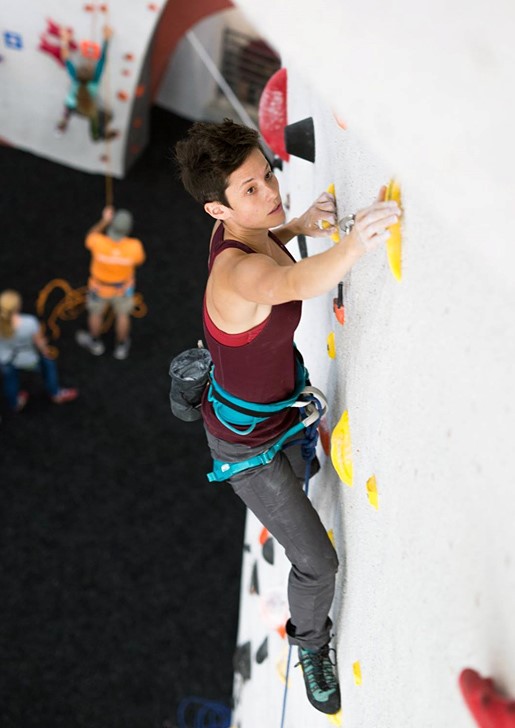
Getting Started
Your first step through the doors of a climbing gym will be eye opening, energizing, and perhaps a bit frightening. For a moment you may even contemplate a retreat from the facility; resist this urge with the knowledge that indoor climbing is completely safe and that you are up to the challenge. Climbing gyms come in all shapes and sizes, ranging from a modest 15-foot-high bouldering wall installed in the corner of a health club up to a massive 50-foot-plus lead climbing monolith common to large commercial climbing gyms in the major metropolitan cities. In addition to paying an entry fee, you’ll need to pony up a few bucks for a pair of climbing shoes, safety harness and chalk bag (worn around your waist and filled with powdery chalk to dry your grip). Like a seat belt, a climbing harness is the most vital piece of safety equipment—it’s the link between your body and the safety rope. Climbing shoes are also important, as the special rubber soles will help your feet stick to the climbing footholds. Prior to engaging in self-directed climbing, most gyms require completion of a brief introductory class. This once-and-done lesson will provide a crash course on the fundamentals of climbing movement, as well as on vital issues of putting on your harness, tying into the rope, and belaying. Belaying is a two-person rope-management technique that allows for safe ascent and descent of the walls. It’s a simple process that takes only a few minutes to learn. Soon enough you’ll be climbing the walls! [caption id="attachment_11725" align="aligncenter" width="948"] Pro climber Eric Hörst with owner Nate Postma at the grand opening of Vertical Endeavors in Bloomington, MN[/caption]
If your palms aren’t sweating yet, let me describe the three basic modes of climbing that await you.
Pro climber Eric Hörst with owner Nate Postma at the grand opening of Vertical Endeavors in Bloomington, MN[/caption]
If your palms aren’t sweating yet, let me describe the three basic modes of climbing that await you.
Bouldering
Bouldering is the most basic form of climbing, as the goal is simply to ascend short sections of wall, called “problems”, that typically range from ten to fifteen feet in height. Given the modest length of boulder problems, there’s no need for a safety rope or belayer. Like climbing around on a jungle gym, you are free to move around these low walls in search of enjoyable moves and a killer pump! Bouldering is also the best activity for practicing footwork, developing balance, and learning to move in your new vertical environment. Since you rarely climb more than several feet off the floor, you can pick a problem and focus on solving it, even if it means jumping off and trying the problem over and over. This process of targeting your efforts on solving a specific sequence will challenge you physically, mentally, and technically, all without the distraction of a rope, belayer, or dauntingly long climb.Toproping
Toproping is the most popular activity for beginners, since it allows safe movement up even the highest, most scary-looking walls. The name toprope describes the rigging of the safety line that runs from the floor up through an anchor atop the climb, then back down to the bottom. Gyms commonly have a dozen or more top ropes hanging in place and ready to go—you just need to tie into one end of the rope and have someone belay you from the other end. Some gyms also possess mechanical auto belay units that will safely guard your ascent in place of a belayer. Like bouldering, toproping is an excellent way to practice climbing skills. With a snug toprope belay, you can safely try your hand at any climb and be softly lowered back to the ground at a moment’s notice. Some toprope climbs will be easy, and you’ll breeze up the wall on your first try. Other routes might spit you off onto the rope (called a “fall”). Fortunately the toprope will hold you in place at the problem spot so you can hang there and work on the sequence. Sometimes it will only take a few tries to unlock the sequence and continue on to the top; other times you may be stymied and you’ll need to lower off and try the climb another day. [caption id="attachment_11723" align="aligncenter" width="720"]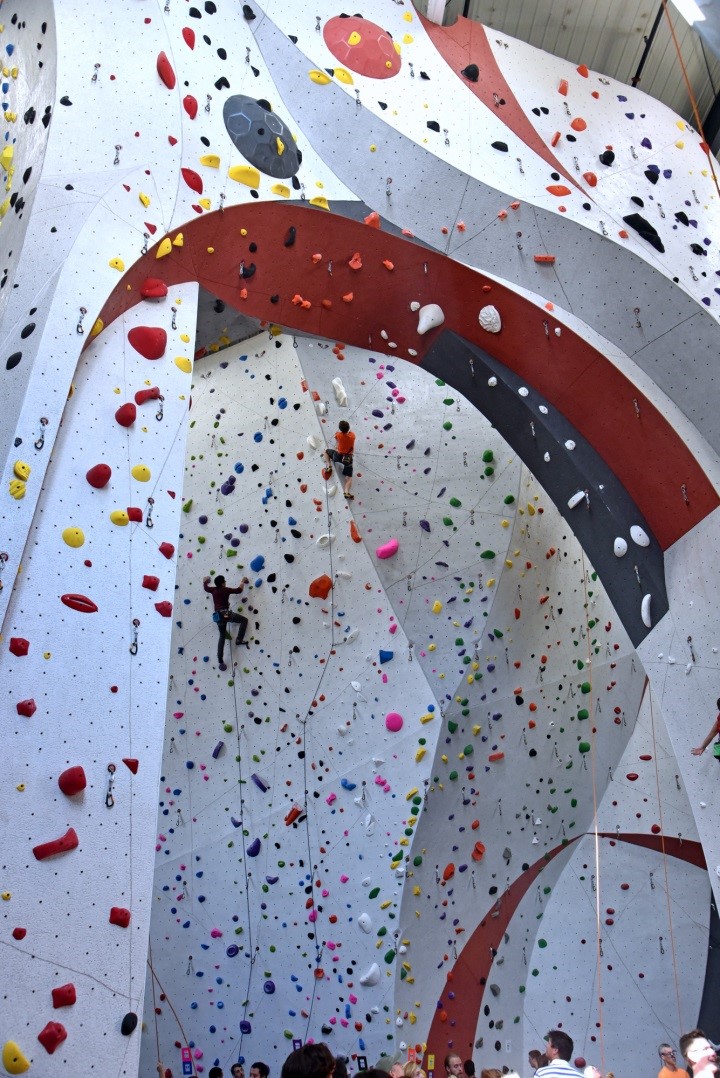 50-foot toprope and lead climbing walls will test your physical and mental endurance![/caption]
Leading
Lead climbing is the most advanced style of climbing as you are challenged to lead the rope from the ground to the top anchors of a climb. Unlike the snug belay afforded by a toprope, the hallmark of lead climbing is the dangling rope that trails from your harness down to the ground. A slip or fall is then arrested by one of the anchor bolts spaced every five feet along the path of the climb. The added physical challenge of lead climbing is clipping the trailing rope into the bolts as you ascend the wall. Mentally, you’ll need to remain calm and confident knowing that a slip-up will yield a true free-fall through the air! Such air falls are usually just five to ten feet in length (until the rope draws tight onto the last anchor bolt), but they will provide an adrenaline rush that you won’t soon forget. Yes, taking such a lead fall is scary at first; however, with the proper safety systems in place it’s surprisingly safe. Consider it a healthy rush that will build character! [caption id="attachment_11724" align="aligncenter" width="749"]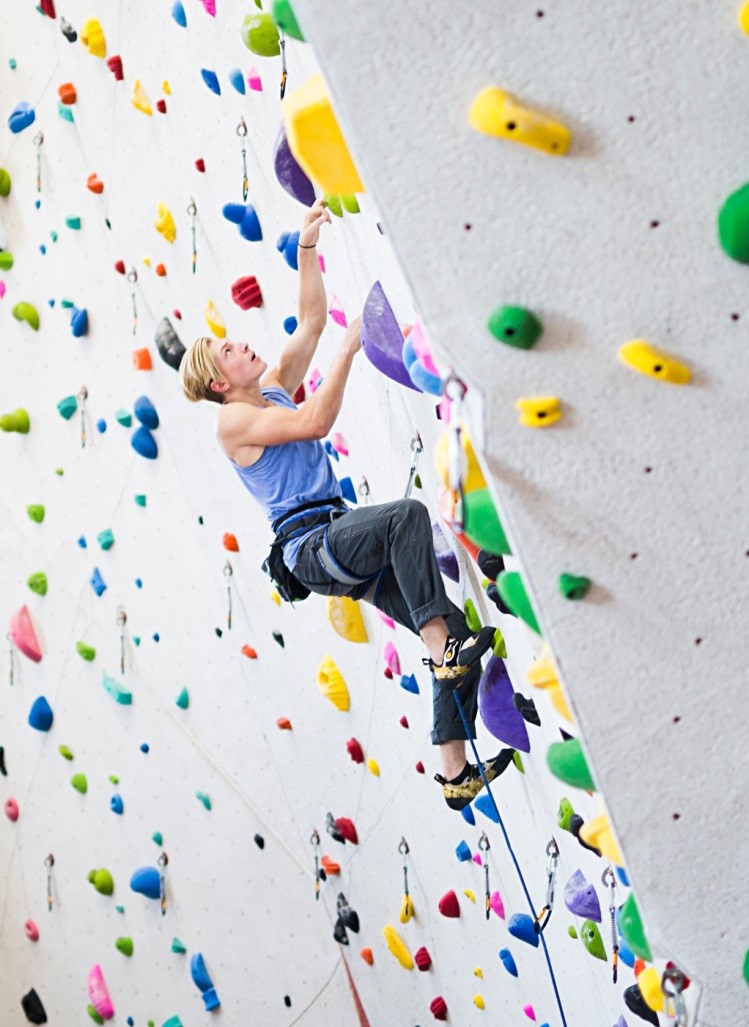 Strong fingers and a focused mind…high up on the lead climbing walls![/caption]
Learning to Climb Outdoors
Indoor climbing and outdoor climbing are vastly different activities, and competency as an indoor climber does not guarantee safe climbing in the great outdoors. It is vitally important that all indoor climbers recognize that there are wide-ranging complexities and dangers to rock climbing in a natural setting. Not even the most realistic indoor facility provides the experience and training needed to transition your climbing outside. Yes, outdoor climbing can be a most gratifying progression for a skilled indoor climber, but you must treat the move outdoors as if you are beginning a new sport from scratch. Don’t even ponder venturing out to the crags by yourself. More than a few novices have tried this approach and ended up with broken bones, or worse. Rule number one of outdoor climbing is to bring a pack load of prudence. For the beginner, this means signing up for a weekend class in outdoor climbing or, better yet, obtaining one-on-one instruction from an American Mountain Guides Association (AMGA)-certified climbing guide. While you can learn the basics of indoor climbing in a day or two, the many nuances of real rock climbing demand several days of quality instruction. If you find the outdoor experience pleasurable, your next step is to join a local climbing club or find an experienced climbing partner to hook up with for regular outings. In the end, you may find the unique experiences afforded by both indoor and outdoor climbing to be equally enjoyable. I, for one, enjoy training on an indoor wall during the workweek, but I do so with the intention of pulling down on some of Mother Nature’s finest on the weekends. Ultimately, you may discover—as have countless others—that rock climbing is an empowering, transcending sport that you can engage in for life. Traveling the country to climb novel rock formations provides limitless opportunity to explore off-road, off-grid, and where few others venture. It’s in the thin mountain air and on the side of sheer rock walls that I feel most alive, and I trust that you will experience similar feelings. Regardless of whether or not your indoor climbing adventures someday lead you into outdoor rock climbing, I trust that you’ll discover great joy and a unique sense of self-exploration in simply going vertical. To me, that’s one of this sport’s greatest rewards—how climbing releases untapped resources, it reveals unknown potentialities, and it provides an endless series of metaphors for effective living. Most people begin climbing for the rush of the new experience, but in time they find it’s the movement, emotion, and discovery—how it makes them feel and grow—that hooks them as climbers for life.Resources
Learning to Climb Indoors: The Complete Guide to Indoor Climbing (by Eric Hörst, Falcon 2012) Visit Training For Climbing to learn more about training for climbers.